
Screen Printing Press Guide: Which Machine Is Right for Your Shop?
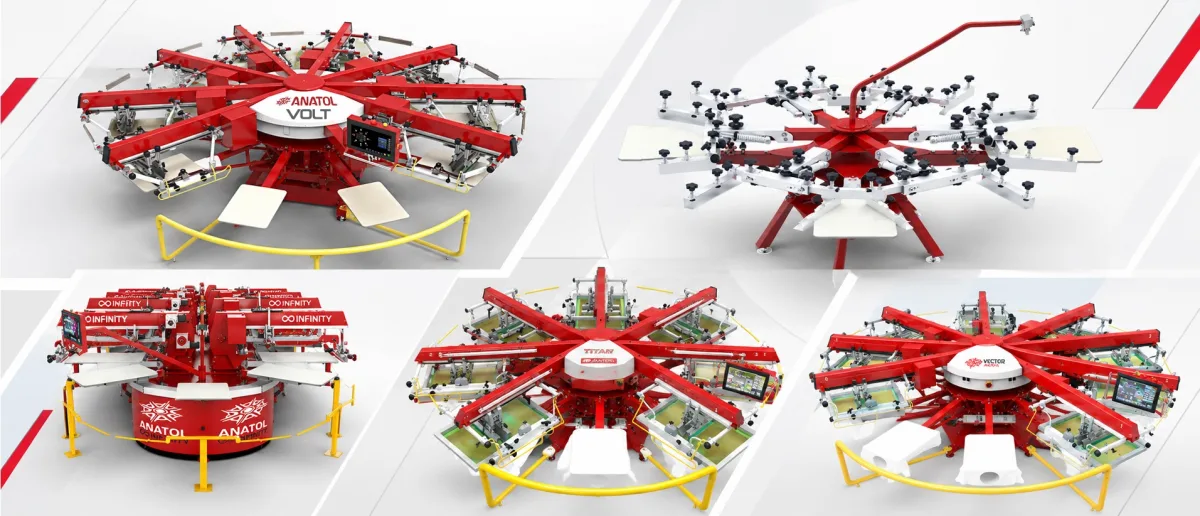
Ask ten printers what makes a great screen printing machine and you'll get ten different answers. Some will talk about registration accuracy down to the fraction of a millimeter. Others care more about how loud the shop gets by hour six of a shift, or how many times a week someone has to crawl under the press to check an air line. The truth is, "screen printing press" is a pretty broad category — a one-person garage studio and a multi-shift production floor both use the term, but they need almost nothing in common from a machine.
So instead of talking in generalities, let's go machine by machine: what each one actually does differently, what it's genuinely good at, and what kind of shop tends to fall in love with it.
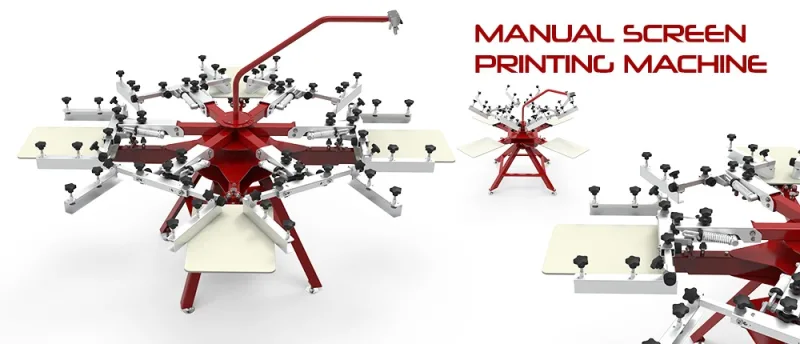
The Manual Press: Thunder
There's a certain irony in the fact that manual presses never went out of style, even as automation took over the industry. Ask any shop owner running a full automatic line why they still keep a manual press in the corner, and the answer is almost always the same: sampling. Nothing beats being able to hand-pull a test print, eyeball it, tweak the pressure, and pull another — all in the time it would take to set up an automatic job.
Thunder, Anatol's manual screen printing press line, leans into exactly that hands-on control. The operator rotates the carousel and lowers the print head by hand at every station, which sounds like a limitation until you realize it's also the whole appeal — total, immediate feedback on every single impression. It comes in configurations from a lean 4 stations/4 colors up to a maxed-out 12/12, built on a heavy steel frame with tool-less head adjustment and a collapsible base that folds down for shops without much square footage to spare.
Best for: shops just getting started, schools and training programs, small studios running short custom runs, and — surprisingly often — established production shops that keep one around purely as a sampling and proofing press.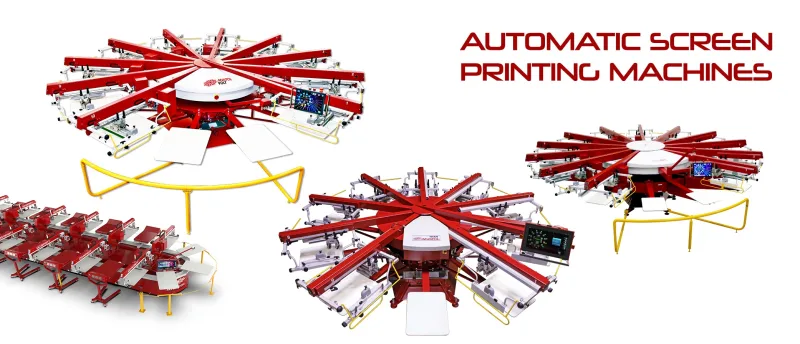
TITAN: The Reliable Workhorse
TITAN is what happens when you take the automatic-press concept and build it around air. Pneumatic cylinders drive the print heads, and depending on the configuration (AAA, ASA, or ASE), varying amounts of the indexing and movement run on air versus servo motors. It's a formula that's been refined for a long time, which is exactly why it still sells: it's dependable, well understood by techs everywhere, and priced to make sense for a shop that's ready to automate without jumping to the top of the catalog.
Best for: growing shops making the leap from manual to automatic for the first time, and anyone who wants proven, well-supported technology over the newest thing on the floor.
VECTOR: Servo Precision, Without Going All-In
VECTOR sits in an interesting middle spot. Most of the motion — indexing, head movement — runs on servo motors, which means tighter, more repeatable registration than pure pneumatics can offer. But it still uses a small amount of compressed air for a couple of functions, so a shop that already has a compressor doesn't have to rebuild its infrastructure to get the upgrade.
It's the machine for a shop that's outgrown the "good enough" precision of a pneumatic press but isn't ready — financially or logistically — to cut the cord on air completely.
Best for: shops upgrading from a pneumatic press that want noticeably better registration accuracy without a full equipment-philosophy change.
VOLT: Print Shop, Minus the Air Compressor
VOLT is the one that tends to get people talking. It's a fully electric automatic press — no pneumatics anywhere in the system. Print heads, carousel indexing, pallet lift, all of it runs on AC servo motors. Which means no compressor humming in the background, no air lines to inspect, no chiller to keep clean, and — something people don't expect until they stand next to one — a noticeably quieter shop floor. Eight hours next to a pneumatic press has a rhythm to it, a hiss-and-thump on every cycle; VOLT just doesn't have that soundtrack.
Take the compressor out of the picture and a surprising amount of a shop's routine maintenance goes with it. Less to service usually means less unplanned downtime, and running costs that are easier to predict month to month.
Best for: shops that want to modernize their whole workflow at once, high-volume operations tired of budgeting for compressor upkeep, and anyone setting up a new floor who'd rather skip pneumatic infrastructure entirely.
INFINITY Oval: Built to Move Volume
Round carousels are the norm, which is exactly why INFINITY's oval shape stands out. The layout is designed specifically to push more pieces through per hour than a traditional round carousel of a similar station count, running on an all-servo drivetrain for the precision to match the throughput.
Best for: high-volume production floors where shaving seconds off each cycle adds up fast — think contract printers and large multi-shift operations.
Color Magic: Not Every Job Is a T-Shirt
It's easy to assume every automatic press on a shop floor is there to print garments, but Color Magic is a reminder that's not the whole picture. It's a single-color flatbed press, purpose-built for posters, signage, and other flat substrates rather than apparel.
Best for: shops that regularly take on sign and poster work alongside — or instead of — textile printing.
Prodigy: Small Footprint, Full Automation
Prodigy takes everything an automatic press does and shrinks it down. It's built for alternate print locations and specialty items — the kind of jobs that don't need a full-size carousel and don't have the floor space for one either.
Best for: shops with limited space, specialty and promotional item printers, and anyone who wants automatic-press consistency without committing a large chunk of the shop floor to it.
The Setup Nobody Talks About: What's Around the Press
The press gets all the attention, but it's rarely working alone. A conveyor dryer cures ink at the pace the press produces it, flash cure units handle spot-curing individual colors mid-run on multi-color jobs, a heat transfer press covers jobs that call for transfers instead of direct printing, and pre-press equipment gets screens exposed and ready before they ever touch a pallet. Talk to any shop that's scaled up, and they'll usually tell you the press was only half the equation — the equipment around it is what actually let them take on bigger and more complex orders.
So, Which One?
There isn't a universal answer, and honestly, most established shops don't run just one machine — they run a mix. A production floor might lean on a VOLT for its everyday apparel volume, keep a Thunder in the corner for proofing new designs, and pull out a Color Magic when a client asks for event posters. The differences between these machines aren't really about which is "better" — they're about which problem you're actually trying to solve on any given day.


